Benchmarks
All benchmarks were run on an Intel Xeon Gold 6234 (8 physical cores, 16 logical processors via HyperThreading) under WSL2. Example data shipped with the package was used throughout: the IVUS rest/stress pullbacks for the step-size benchmark and the OCT pullback (280 frames) for the parallelization benchmark.
1. Algorithmic improvement: bruteforce vs. optimized
The optimized alignment algorithm uses a coarse-to-fine hierarchical search instead of evaluating every candidate angle exhaustively. The effect is small at coarse step sizes (few angles to evaluate) but grows rapidly as the step size decreases, because the number of candidate angles scales as \(n = 2 \times \text{range} / \text{step}\).
Test setup — from_file_full on the IVUS rest/stress example data,
range_rotation_deg = 90°, write_obj = False, smooth = False,
postprocessing = False. Three repetitions per condition; median wall time
reported.
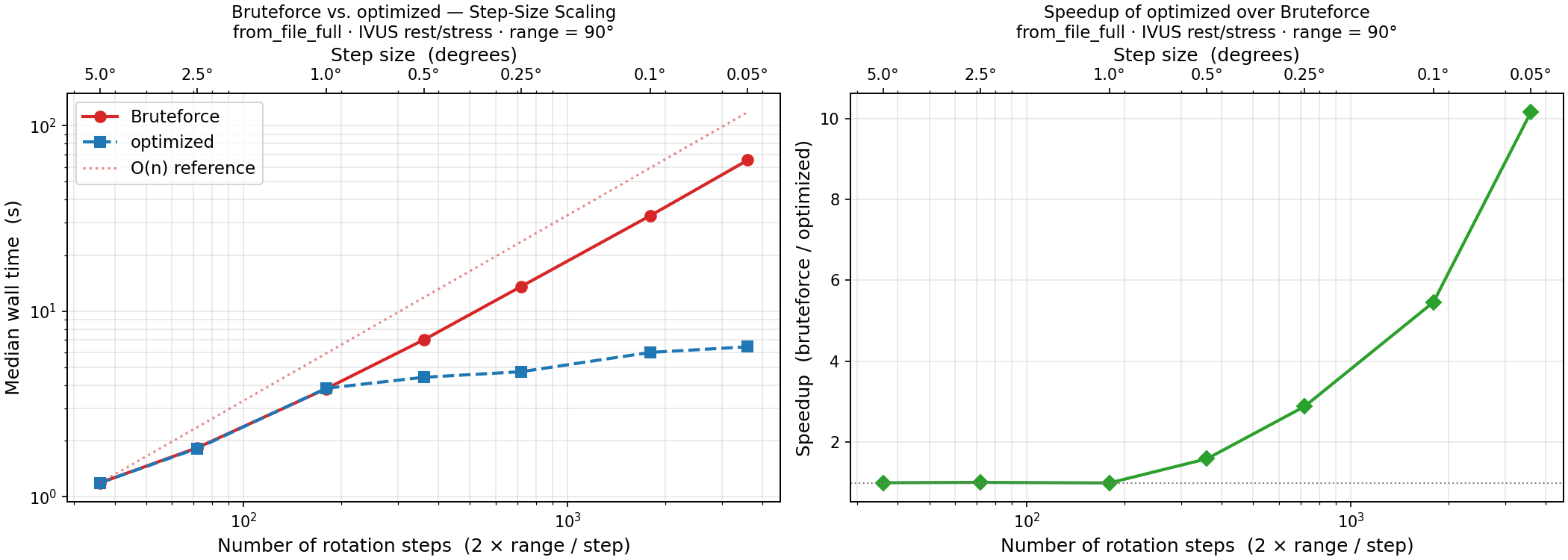
Fig. 7 Wall time (left, log-log) and speedup factor (right) of the optimized algorithm over bruteforce as a function of the rotation step size. The O(n) reference line confirms the linear scaling of bruteforce with the number of candidate angles; the optimized search is sub-linear.
At step sizes of 1° and above the difference is modest (< 2x). Below 1° the gap widens substantially: at 0.1° the optimized algorithm is 5.5x faster and at 0.05° the advantage grows to 10.3x (6.25 s vs. 64.4 s). This is the practically relevant regime: fine step sizes are required for high-accuracy alignment of OCT data and dense IVUS pullbacks.
2. parallelization scaling
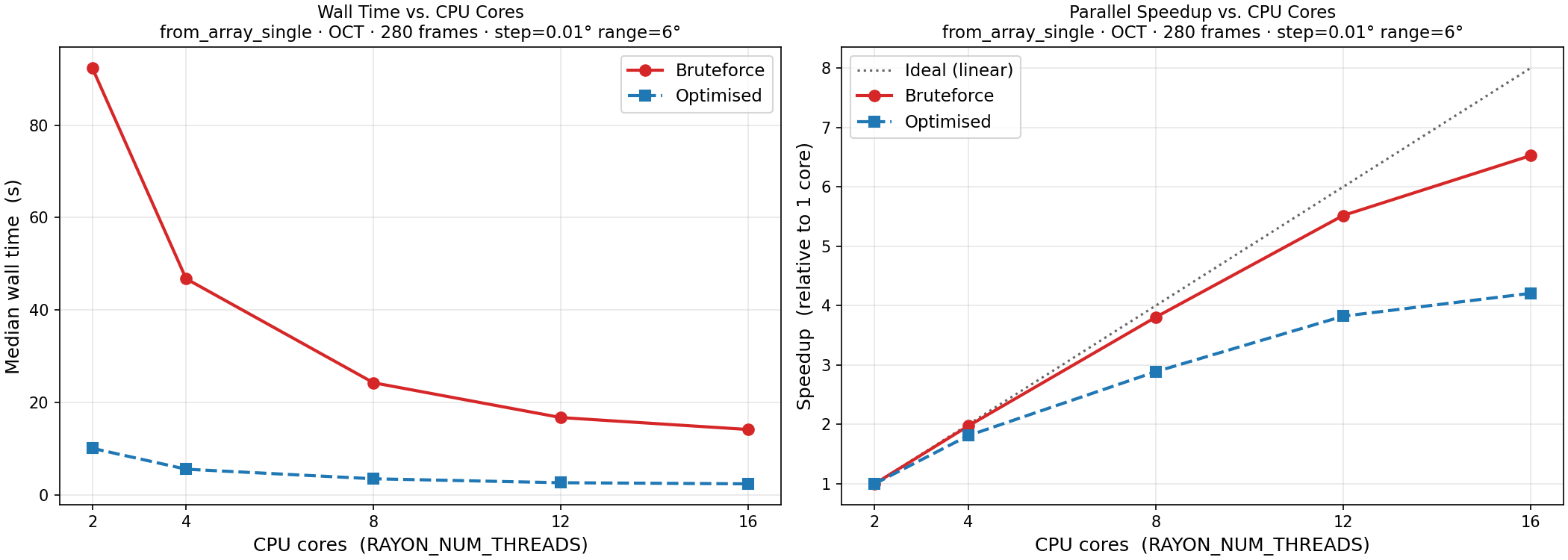
The second benchmark tests how much additional speed is gained by increasing
the number of CPU cores, using from_array_single on the OCT dataset
(280 frames, step_rotation_deg = 0.01°, range_rotation_deg = 6°).
Each core count was run in a fresh subprocess so that rayon’s global thread
pool re-initialises from RAYON_NUM_THREADS.
Cores |
Bruteforce (s) |
optimized (s) |
Alg. speedup |
Core scaling (opt.) |
|---|---|---|---|---|
2 |
92.36 |
10.08 |
9.2x |
1.00x (baseline) |
4 |
46.78 |
5.56 |
8.4x |
1.81x |
8 |
24.27 |
3.49 |
7.0x |
2.89x |
12 |
16.74 |
2.64 |
6.3x |
3.82x |
16 |
14.15 |
2.40 |
5.9x |
4.20x |
Key observations
Parallelizing the angle search inside
search_range(rather than the point-rotation loop) provides enough rayon tasks per frame to utilise cores effectively: bruteforce scales 6.5x from 2 to 16 cores, optimized scales 4.2x — both close to practical expectations under Amdahl’s law given the sequential frame-dependency chain.The previous 8-core anomaly (WSL2 HyperThreading interference) has disappeared. With hundreds of angle-evaluation tasks per frame, rayon keeps all workers busy and the idle HT sibling effect is negligible.
The optimized algorithm remains 5.9-9.2x faster than bruteforce at every core count, with the gap slightly narrowing at higher core counts because bruteforce has more angles to parallelize and therefore scales more aggressively.
The two gains compound: relative to bruteforce at 2 cores (92.4 s), the optimized algorithm at 16 cores (2.40 s) achieves a combined 38.5x speedup — roughly 9x from the algorithm and 4x from parallelization.
Conclusion — algorithm choice and hardware scaling are now both meaningful levers. For the best achievable throughput, use the optimized algorithm on as many cores as available; for rapid prototyping where accuracy matters less, coarser step sizes reduce runtime regardless of core count.
3. CCTA pipeline: spatial indexing and Rust migrations
The CCTA labeling/stitching pipeline (label_geometry, stitch_ccta_to_intravascular)
originally spent most of its time in brute-force O(N × M) point/face searches (every mesh
vertex checked against every centerline point, every excluded face, or every other point in a
cleanup set) and in several pure-Python per-vertex/per-face loops. Both problems were fixed
by (a) replacing the brute-force searches with R-tree spatial indexes (rstar) and (b) moving the remaining hot pure-Python loops into Rust.
Test setup — reference dataset NARCO_119.stl (25,171 vertices, 50,338 faces) with
matched aorta/RCA/LCA centerlines, anomalous_rca=True. All “before”/”after” pairs below
were measured on identical input; the two rows marked with † also benefited from a debug →
release Rust build correction found partway through the optimization pass, so their ratio
somewhat overstates the isolated algorithmic contribution — every other row is a fair
comparison regardless of build type (either both sides are the same build, or the “before”
side is pure Python/NetworkX, where build type doesn’t apply).
Function |
What changed |
Before |
After |
Speedup |
|---|---|---|---|---|
|
Nested-loop O(N×M) → R-tree over centerline points, O((N+M) log M) |
22.4 s |
0.236 s |
~95× |
|
Python O(N×M) nearest-vertex scan → Rust, R-tree over mesh vertices |
3.184 s |
0.025 s |
~127× |
|
Python/NetworkX BFS over face-adjacency graph → Rust BFS (same algorithm, verified byte-for-bit identical output) |
3.898 s |
0.105 s |
~37× |
|
Python per-vertex adjacency-based label loop → Rust |
0.293 s |
0.043 s |
~7× |
|
Python per-vertex set-difference loop → Rust, exact-match hash lookup |
0.217 s |
0.063 s |
~3.4× |
|
Two nested O(N×(N+M)) linear scans → R-trees over both point sets |
1.28 s |
0.04 s |
~32× |
|
Point-vs-excluded-face linear scan → R-tree over excluded faces’ vertices |
4.35 s |
0.04 s |
~99× |
Full example pipeline ( |
All of the above, cumulative, plus the debug → release build correction |
~190 s |
~24 s |
~8× |
Key observations
The largest single win is
find_centerline_bounded_points_simple: swapping a brute-force rolling-sphere check for an R-tree query over the (much smaller) centerline point set turns an O(N × M) scan into O((N + M) log M) — a ~95× reduction on its own, with no change in output.Several hotspots were pure-Python loops doing real per-vertex/per-face work (nearest-vertex search, adjacency traversal, set differences, mesh-winding correction). Moving each into a Rust binding removed the Python interpreter overhead entirely, independent of the R-tree question —
fix_mesh_windingin particular is a faithful Rust port of trimesh’s ownrepair.fix_windingBFS algorithm, not a different algorithm, and its output was checked byte-for-bit against trimesh’s directly.Not every brute-force search was worth optimizing: ray-triangle intersection testing in
remove_occluded_points_ray_triangle(the “Pass A” ray-casting step, distinct from the face-exclusion pass in the table above) dropped to a non-bottleneck once the release-build correction landed, so it was deliberately left as a plain nested loop — it reads more clearly than a BVH/AABB-pruned version would, and optimizing further would not have moved the total pipeline time.
Conclusion — for point-cloud and mesh-topology operations of this kind (nearest-neighbor search, radius queries, exact-match set operations, adjacency traversal), the two effective levers are (1) replace any brute-force all-pairs search with a spatial index built over the smaller side, and (2) if a hot loop is doing real per-item work in pure Python — including inside a third-party library — port it to Rust rather than trying to vectorize it away in NumPy.